Bolivia Opens the Door to Private Fuel Imports: Legal and Business Implications of Supreme Decree No. 5644
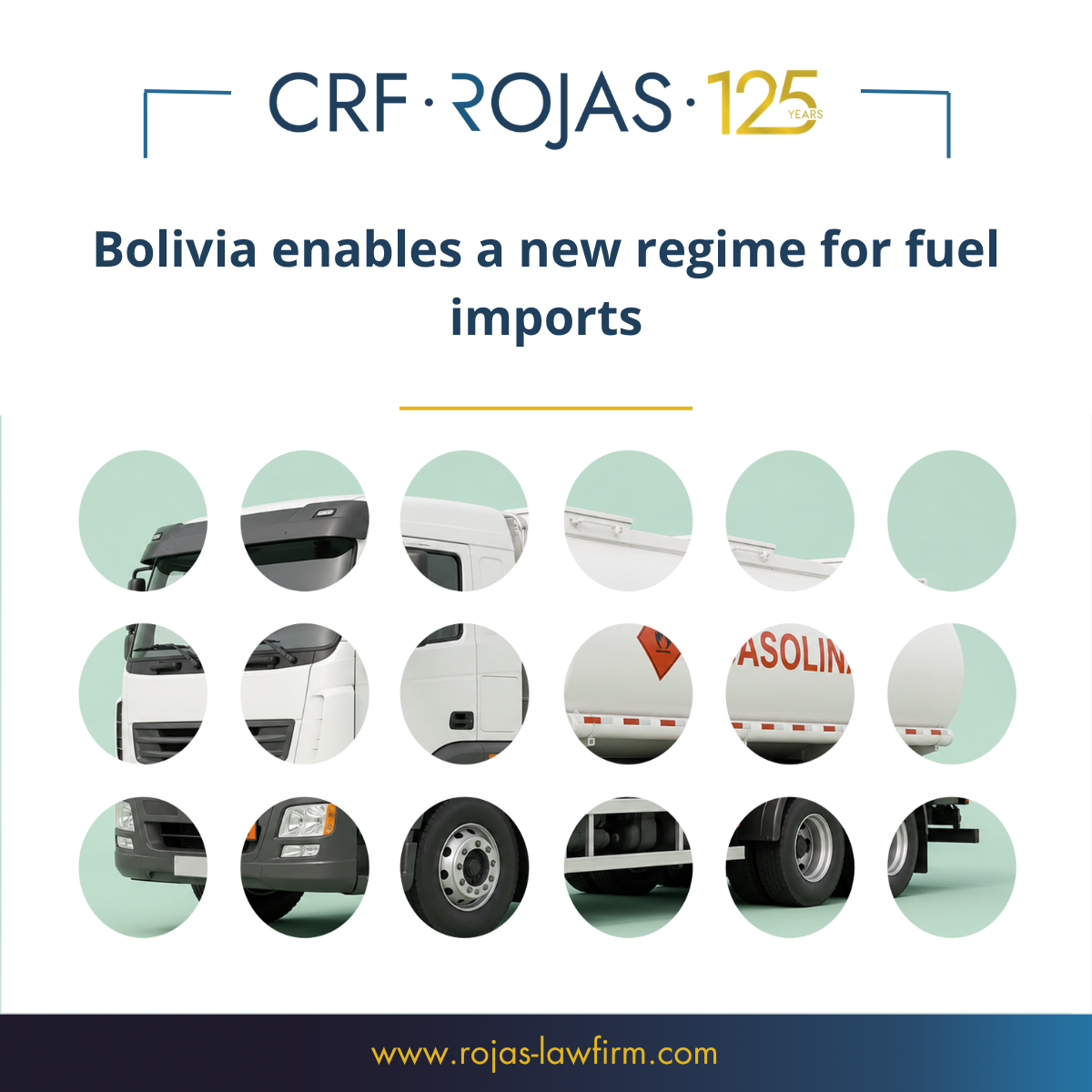
Supreme Decree No. 5644 exceptionally authorises public and private persons and entities to import petroleum derivatives for own use and/or commercialisation in the domestic market.
Supreme Decree No. 5644, issued on 29 June 2026, introduces a new framework for the import and commercialisation of petroleum-derived products in Bolivia. The Decree is adopted in the context of the energy and social emergency established by Supreme Decree No. 5517 and seeks to strengthen domestic supply through greater participation by both the public and private sectors.
The change matters because it creates a formal route for private actors to import fuels and other petroleum derivatives, whether for own operational use or commercial sale. In a country where fuel supply has historically been concentrated around YPFB and regulated prices, the Decree introduces a more flexible, but also more complex, architecture.
The result is a dual regime: on the one hand, the traditional circuit of fuels commercialised by YPFB at regulated prices; on the other, privately imported diesel and gasoline sold at market prices. The opportunity lies in supply. The risk lies in traceability, product separation and regulatory execution.
An exceptional opening of the fuel market
The Decree exceptionally authorises public and private individuals and entities to import petroleum-derived products for commercialisation or own use.
It distinguishes between:
- fuels, meaning petroleum derivatives mainly used in internal combustion engines; and
- non-fuel derivatives, used primarily as raw materials or functional products.
This opening does not displace YPFB. The state-owned company retains a central role in importing and commercialising fuels and non-fuel derivatives. However, the Decree allows other public entities to import only for own use, while private actors may import for both own use and commercialisation in the domestic market.
From an economic perspective, the measure recognises a practical reality: in an energy emergency, security of supply may require more channels, more operators and greater logistical flexibility.
Market prices for privately imported diesel and gasoline
One of the most important provisions of the Decree is that diesel and gasoline imported by private individuals or entities will be commercialised at market prices.
This creates a fundamental distinction from fuel commercialised by YPFB, which remains subject to the applicable regulated price regime.
The practical result is the coexistence of two economic logics:
- YPFB fuel under regulated prices; and
- privately imported fuel under market prices.
This design may help increase availability, especially for sectors with high operational demand, such as agribusiness, mining, construction, transport, logistics, power generation, industry and wholesale commerce. But it also requires strict controls to prevent arbitrage, improper mixing, resale or distortions between subsidised and imported products.
Authorisations: ANH and DGSC as central authorities
Import and commercialisation under the new framework are not free activities. They are subject to authorisation and control.
The National Hydrocarbons Agency (ANH) will issue authorisations for the import of fuels and non-fuel derivatives, or for import for own use, in accordance with applicable regulations and the rules to be issued by the Ministry of Hydrocarbons and Energy.
In addition, the Directorate General of Controlled Substances (DGSC) will issue prior import, commercialisation and local purchase authorisations where applicable.
For companies, this is essential. The model cannot be analysed merely as a foreign trade operation. Fuel imports require an integrated review of hydrocarbons regulation, customs, controlled substances, logistics, quality, storage, commercialisation and sanctions.
Private commercialisation: rules by volume and channel
The Decree establishes specific conditions for the commercialisation of privately imported diesel and gasoline.
For volumes equal to or greater than 5,000 litres, sale may take place directly from owned or leased storage plants, or from refineries, to final consumers, service stations or liquid fuel sales points, subject to ANH regulations.
For volumes below 5,000 litres, operators must be incorporated as service stations under the applicable rules.
Service stations and sales points may commercialise both YPFB fuel and privately imported fuel at the same time, provided they comply with differentiation mechanisms for infrastructure, volume, storage and prices.
This may be one of the most operationally sensitive aspects of the Decree. Allowing regulated and market-price products to coexist in the same channels requires physical, documentary and commercial separation. In practice, service stations, distributors and importers will need strong internal controls to avoid product mixing, confusion or pricing violations.
Own use: a tool for fuel-intensive sectors
The Decree defines own use as the volume of fuel acquired exclusively for use in the importer’s own operational activities, without resale or commercialisation to third parties.
This may be particularly relevant for fuel-intensive businesses, including agribusiness, mining, transport, construction, logistics, manufacturing and power generation.
For these sectors, importing or acquiring imported fuel for own use may become an operational continuity tool, especially where domestic supply is insufficient or uncertain.
However, the legal boundary is clear: fuel acquired for own use cannot be resold or commercialised to third parties. The company must be able to evidence destination, traceability and internal use.
Quality, traceability and reporting
Market opening comes with quality and traceability obligations.
Fuels and non-fuel derivatives imported for commercialisation or own use must comply with the technical quality parameters established by applicable regulations, the Ministry of Hydrocarbons and Energy and the ANH.
Before fuels enter Bolivian territory, authorised importers must report and register with the ANH at least:
- the volumes to be imported; and
- full analysis documents supporting the quality of each imported batch.
The ANH may also request additional information or documentation and issue instructions at any time within the scope of its functions.
In practical terms, traceability will be the centre of gravity of the new regime. Importing product will not be enough. Companies must be able to show what was imported, in what volume, with what quality, through which channel it was sold or consumed, and under which authorisation.
Prohibitions: protecting the regulated product circuit
The Decree includes several prohibitions designed to prevent arbitrage between YPFB fuel and privately imported fuel.
In particular, it prohibits:
- resale or commercialisation to third parties of diesel or gasoline from YPFB acquired by final consumers, direct users, direct clients or GRACOs;
- transfer, mixing or any combination of YPFB products with imported products;
- commercialisation of YPFB diesel or gasoline at market prices;
- commercialisation of YPFB products mixed with privately imported fuel.
These rules are essential to preserve the separation between the regulated circuit and the market-price circuit. They also reflect an obvious concern: where regulated prices and market prices coexist, the risk of arbitrage, mixing or resale increases.
Sanctions
The Decree classifies infringements as minor, serious and very serious.
Minor infringements include failures to report, register or submit information. Serious infringements include false or altered information, failure to comply with commercialisation conditions and non-compliance with ANH instructions. Very serious infringements include commercialising without valid authorisation, reselling YPFB fuel, mixing imported products with YPFB products, selling YPFB fuel at market prices or selling YPFB products mixed with imported fuel.
Sanctions include:
- a UFV 2,000 fine for minor infringements;
- a UFV 5,000 fine for serious infringements;
- a UFV 10,000 fine for certain very serious infringements; and
- revocation of the operating licence and/or import and commercialisation authorisation for the most sensitive very serious infringements.
For companies in the sector, the sanctions regime should be treated as a central element of market-entry analysis. The economics of importing fuel can quickly disappear without adequate controls over authorisation, quality, traceability, storage, pricing and sales channels.
Tax and tariff incentives
The Decree establishes a specific Special Tax on Hydrocarbons and Derivatives (IEHD) rate of Bs0/L until 31 December 2030 for imports of diesel and gasoline.
It also defers Customs Duty to 0% until 31 December 2026 for certain gasoline tariff subheadings.
These incentives matter because they reduce the fiscal cost of imports and may improve the economic viability of the model. The real impact, however, will depend on international prices, freight, insurance, internal logistics, storage, authorisation costs, quality controls, financing and final sale price or own-use cost.
Pending regulations and timing
The Decree requires supplementary regulation.
The Ministry of Hydrocarbons and Energy must approve, by Ministerial Resolution, the rules on requirements and procedures for import authorisations within 10 business days from publication of the Decree.
The ANH must then issue the relevant Administrative Resolution within 15 business days from publication of that Ministerial Resolution.
The Ministry of Government must also approve requirements and procedures for registrations, prior import authorisations, production authorisations, commercialisation authorisations and other fuel-related procedures.
The Decree enters into force once the ANH Administrative Resolution is published. Companies interested in the regime should therefore monitor secondary regulation closely before structuring operations.
Practical implications for companies
Companies interested in importing, commercialising or consuming imported fuel should review:
- whether the product qualifies as fuel or non-fuel derivative;
- whether the import is for own use or commercialisation;
- required ANH authorisations;
- applicable DGSC authorisations;
- storage, transport and distribution capacity;
- international supply contracts;
- customs and import logistics;
- batch quality controls;
- documentary traceability and reporting systems;
- physical and commercial separation between YPFB and imported product;
- pricing model and margins;
- sanctions exposure;
- impact of Bs0/L IEHD and 0% Customs Duty;
- pending implementing regulations.
Conclusion
Supreme Decree No. 5644 is one of Bolivia’s most relevant measures to address the fuel supply emergency. It opens a door that had long been tightly controlled: private participation in the import of petroleum-derived products for own use and commercialisation.
But opening does not mean deregulation. The framework combines market prices for privately imported fuel with strong controls on authorisation, quality, traceability, product separation, controlled substances and sanctions.
For companies, the opportunity is clear: greater ability to secure supply in a constrained energy environment. But execution will require regulatory and operational discipline. In this new market, the fuel will matter as much as the documentation that travels with it.