Bolivia Ends the Fixed Exchange Rate Era: Legal and Business Implications of Ministerial Resolution No. 245/2026
Executive Summary
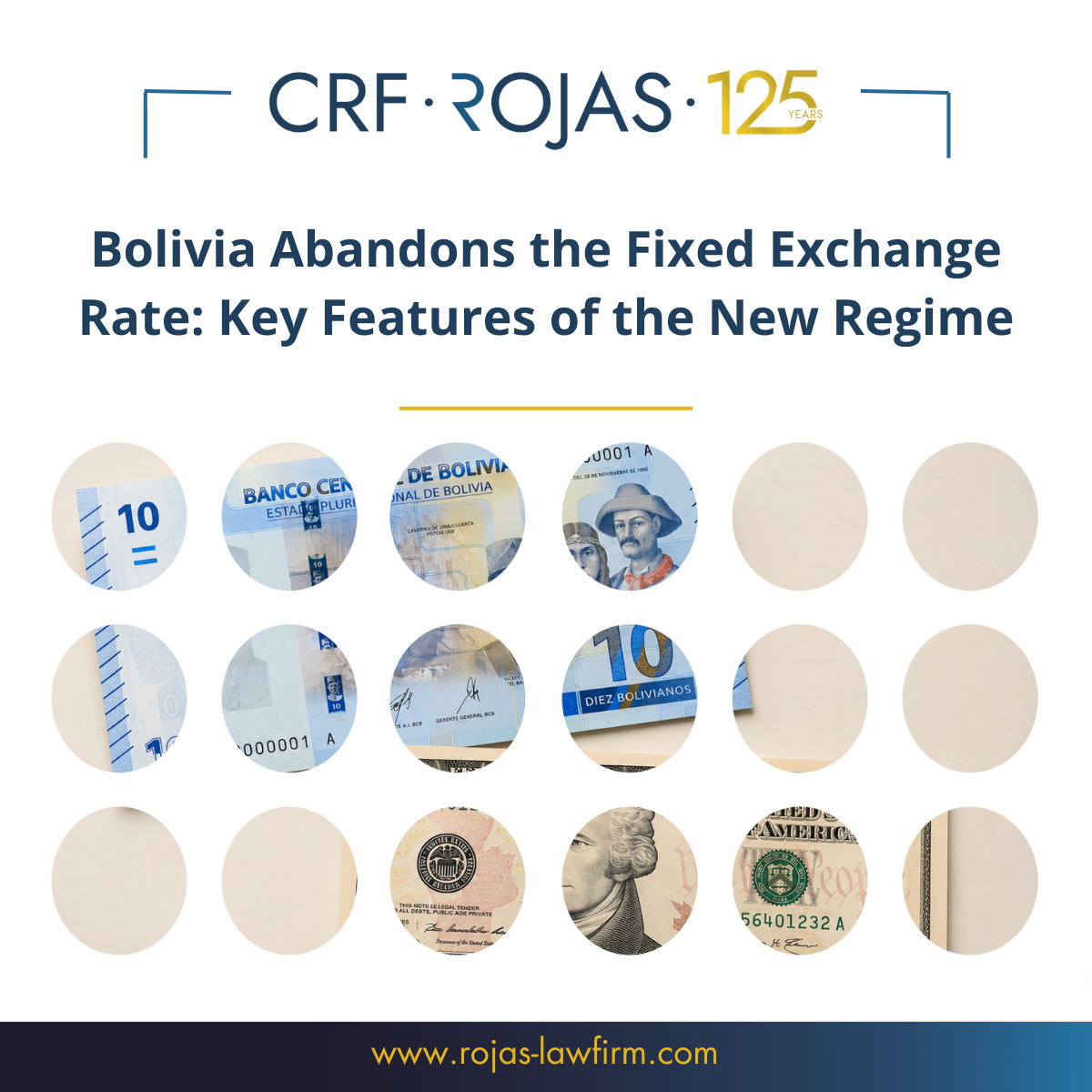
As of Monday, 29 June 2026, Bolivia has abandoned the fixed exchange rate of Bs 6.96 per US dollar — in place for nearly 15 years — and moved to a flexible exchange-rate regime. The first Official Exchange Rate (OER) under the new framework was set at Bs 9.73 per US dollar, representing an increase of approximately 40% compared with the previous rate.
The OER is now calculated and published daily by the Central Bank of Bolivia (BCB), based on the weighted average of actual foreign-currency purchase transactions carried out within the financial system. The measure affects imports, exports, the calculation of customs duties and taxes (effective from 4 July), US dollar-denominated contracts, debt, salaries, accounting and tax liabilities. This bulletin summarises the new framework and our recommendations.
1. What changed from a regulatory perspective
The change was implemented through two regulations issued on 26 June 2026, effective from 29 June:
- Ministerial Resolution No. 245/2026 (MEFP): establishes a flexible exchange-rate regime aimed at strengthening macroeconomic stability, preserving external competitiveness and contributing to balance-of-payments equilibrium. It provides that the transition is to be implemented by the BCB based on the recognition of daily foreign-currency supply and demand within the financial system.
- Board Resolution No. 88/2026 (BCB): amends the Foreign Exchange Transactions Regulations and provides that the Official Exchange Rate (OER) is to be determined daily as the weighted average of US dollar purchase transactions carried out by financial institutions with their customers. The BCB publishes the OER on each business day from 8:00 p.m. onwards on www.bcb.gob.bo; the published rate applies on the following day.
The fundamental legal development is not the calculation methodology — which was already used for the so-called “reference exchange rate” — but its legal effect. A rate that was previously merely referential now becomes the State’s official exchange rate, applicable to public-sector transactions, accounting records and, more generally, foreign-exchange transactions throughout the country. The coexistence of a fixed official exchange rate and a parallel market reflecting actual market conditions therefore comes to an end.
2. Why the measure was adopted
The fixed-rate regime became unsustainable due to the significant decline in Net International Reserves (NIR) — now at low levels and with limited availability of liquid foreign currency — the contraction in YPFB’s hydrocarbon exports, the widening fiscal deficit and demand for US dollars that the BCB could no longer meet. Since early 2023, this shortage had given rise to a parallel US dollar market, with a variable exchange rate above the official rate, and a significant portion of economic transactions was already being conducted at values close to market levels. The Government describes the measure as a “realignment” of the exchange rate; critics regard it as formal recognition of a devaluation of the boliviano.
The new regime reduces distortions and creates a single exchange-rate benchmark, with an inflationary impact that some economists expect to remain contained in the short term. Nevertheless, there are warnings that, absent fiscal discipline and a recovery in foreign-currency inflows, the new framework could result in volatility, price pressures and higher import costs.
3. Business impacts by area
3.1 Imports
Importers face a higher and, above all, variable replacement cost. The increase in costs and uncertainty as to the US dollar rate at which each transaction will be completed affect margins, price lists and working capital. The positive counterpart is that a single benchmark reduces the gap between the official and parallel US dollar rates, which had already been increasing import costs.
3.2 Exports
This is the sector that is relatively favoured: each US dollar of export revenue now translates into more bolivianos, improving competitiveness and margins in tradable sectors such as agribusiness, export manufacturing and mining. Companies should review sales contracts, foreign-currency settlement terms and pricing policies in order to capture the benefit without creating contingencies.
3.3 Customs and the calculation of customs duties and taxes
Bolivia’s National Customs Authority will apply the flexible regime to the calculation of the taxable base of Goods Declarations (Declaraciones de Mercancías or DMs) using a weekly update mechanism, pursuant to Article 20 of the Regulations to the General Customs Law (Supreme Decree No. 25870):
| Goods Declarations | Applicable exchange rate |
| Accepted up to Friday, 3 July 2026 | Previous applicable methodology (Bs 6.96) |
| Accepted from Saturday, 4 July 2026 onwards | BCB OER in force on the last business day of the preceding week (previous Friday) — weekly, not daily, reference |
Practical implication: although the OER fluctuates daily, customs duties and taxes — including customs tariffs, import VAT and the Specific Consumption Tax (ICE) — are calculated using the exchange rate applicable on the preceding Friday. This provides weekly predictability for import costing, but requires careful planning of the DM acceptance date, as it may determine the applicable exchange rate.
3.4 Commercial and financial contracts
The impact on each contract depends on its wording: the agreed currency, the existence of a value-maintenance clause, the nature of the obligation and its stage of performance. As a general rule under the Civil Code (Articles 404 to 406), foreign-currency obligations may be discharged in bolivianos at the exchange rate applicable on the due date, unless otherwise validly agreed.
Under a flexible regime, the key question is no longer theoretical: which exchange rate governs the payment, adjustment or readjustment of each obligation? Exchange-rate clauses, force majeure provisions, hardship clauses, price-adjustment mechanisms and indexation provisions should therefore be reviewed.
3.5 Foreign-currency debt and credit
Boliviano-denominated loans — which account for the vast majority of the financial system — retain unchanged instalments and interest terms. By contrast, US dollar-denominated obligations, including private loans, external financing and anticrético arrangements, become more expensive in boliviano terms if the OER continues to rise, increasing the effective debt burden for borrowers.
Particular attention should be paid to US dollar-denominated anticrético agreements and to intra-group debt or obligations owed to foreign suppliers.
3.6 Salaries and labour matters
Salaries must be paid in legal tender — bolivianos — unless the employment contract expressly provides for payment in foreign currency. Where remuneration, bonuses or benefits are denominated in or indexed to US dollars, movements in the OER increase the labour cost in bolivianos and may give rise to claims regarding the calculation basis for statutory bonuses, severance and social-security contributions.
We recommend reviewing compensation policies, currency clauses and any “value-maintenance” commitments, while taking due account of the principles of non-waiver and non-reduction of labour rights.
3.7 Accounting, financial statements and taxation
Recognition of the new OER as the official exchange rate affects the valuation of foreign-currency assets and liabilities, the recognition of foreign-exchange gains and losses in profit and loss, compliance with financial covenants and the determination of taxable bases for taxes linked to the US dollar.
Companies should anticipate the accounting treatment of exchange differences, their impact on Corporate Income Tax (IUE) and the effect on indicators reported to banks, regulators and parent companies.
4. Sector-by-sector perspective
| Sector | Main exposure |
| Consumer goods / Retail | Higher and variable cost of imported goods and inputs; review pricing, supply contracts and inventory turnover. Risk of pass-through to consumer prices. |
| Oil & Gas | Revenues and benchmarks frequently denominated in US dollars; review sales contracts, royalties, fuel subsidies and obligations towards the State and partners. |
| Technology and Services | Licences, cloud services and foreign suppliers paid in US dollars increase costs; opportunities for service exporters billing in foreign currency. |
| Agribusiness | Exporters benefit from higher boliviano proceeds; monitor imported input costs, including agrochemicals and machinery, and commercialisation contracts. |
| Mining | US dollar revenues improve margins; review royalties, export contracts, financing arrangements and foreign-exchange hedging. |
| Financial Services | Management of currency mismatches, US dollar loan portfolios and foreign-exchange positions; customer communications and compliance with ASFI/BCB instructions. |
| Manufacturing / Industry | Mixed position: more expensive imported inputs versus potential export gains; hedging and renegotiation of supply contracts are key. |
5. Recommendations
- Audit foreign-exchange exposure. Identify all US dollar-denominated or official exchange-rate-indexed assets, liabilities, contracts and cash flows, and quantify the impact of the move to Bs 9.73 and potential future volatility.
- Review and, where appropriate, renegotiate contracts. Analyse currency, value-maintenance, price-adjustment, force majeure and hardship provisions; determine which exchange rate governs each payment and incorporate an appropriate allocation of foreign-exchange risk into new contracts.
- Plan customs operations. Schedule the acceptance date of Goods Declarations taking into account the weekly methodology based on the preceding Friday’s rate, in order to optimise import tax costs from 4 July onwards.
- Manage foreign-exchange risk. Assess available hedging mechanisms, currency matching between revenues and obligations, supplier payment terms and pricing policies in order to preserve margins.
- Review labour and compensation policies. Verify remuneration and benefits denominated in or indexed to US dollars, taking into account the non-waivability of labour rights and the calculation of statutory bonuses and severance payments.
- Anticipate accounting and tax closing implications. Coordinate with advisers regarding the treatment of foreign-exchange differences, their effect on IUE, financial covenants and indicators reported to banks and parent companies.
- Monitor the OER daily. Incorporate consultation of the official BCB rate — published on each business day at 8:00 p.m. — into treasury, costing and invoicing processes.
- Document and communicate. Keep a record of decisions adopted and communicate them in an orderly manner to customers, suppliers and financiers in order to reduce contingencies and disputes.
6. How we can assist
Our team is assessing the impact of the new exchange-rate regime for clients across a range of industries. We can assist with the review and renegotiation of contracts, the design of exchange-rate clauses, customs and tax planning, the adaptation of labour policies and the integrated management of foreign-exchange risk.
Each transaction may produce different legal consequences depending on its particular circumstances, and we therefore recommend a specific and timely analysis.
Legal Notice. This bulletin is provided solely for general informational purposes; it does not constitute legal, tax or financial advice and does not create any professional relationship. The information is based on legislation and publicly available sources as of the date of preparation (29 June 2026) and may change. Before taking any decision, we recommend obtaining professional advice tailored to your specific circumstances.
Puedo también hacer una segunda pasada para darle un estilo más “top international law firm client alert”, con terminología más cercana a Clifford Chance, Baker McKenzie o Freshfields.